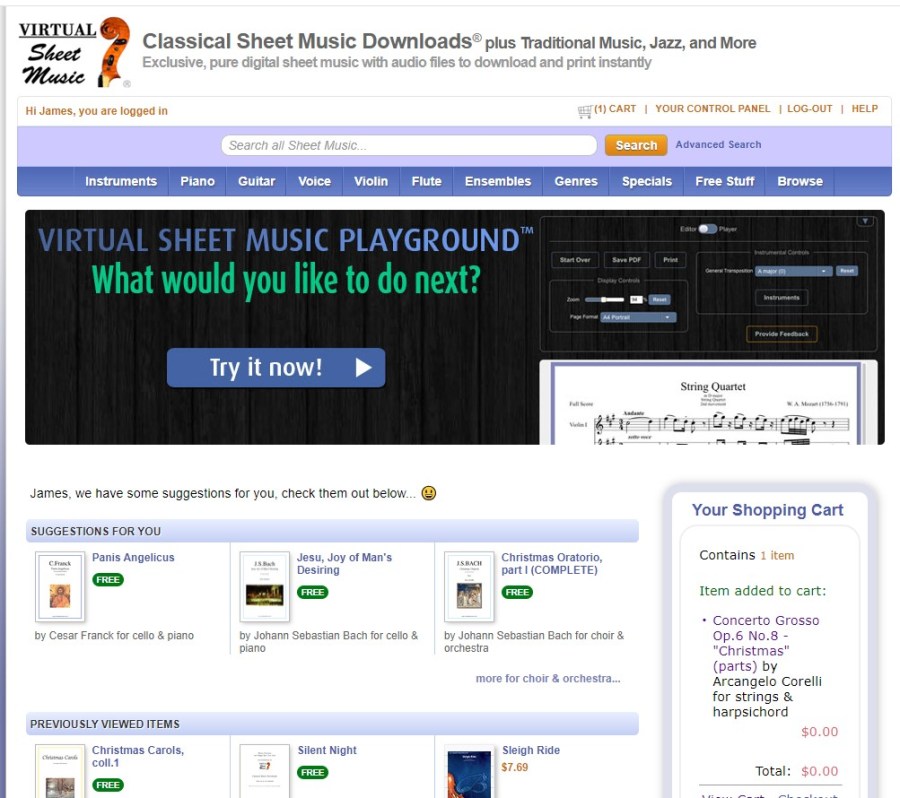
While searching for a version of Corelli’s ‘Christmas’ Concerto arranged for 20 cellos (don’t ask !) I came across what looks like a very useful website. Basically it is source of editable sheet music and includes a vast array of classical music.
link up with other string players
While searching for a version of Corelli’s ‘Christmas’ Concerto arranged for 20 cellos (don’t ask !) I came across what looks like a very useful website. Basically it is source of editable sheet music and includes a vast array of classical music.

After a decade of mouldering in the back of the wardrobe, the violin is now once again part of my life. And I can’t imagine going back… Charlotte Higgins. The Guardian. Nov 2009.
This is an article by Charlotte Higgins, describing her return to playing chamber music after many years. She manages to describe exactly the experience we all have, playing string quartets together. A very perceptive article, well worth a read in full. Find it here.
“Why is it, then, so wonderful? Well, once in a while, we just click into place: there comes a fleeting moment when each of us, playing highly individuated and often wildly complicated parts, actually become an ensemble. We … blend. This is a tremendously intense feeling, and hard to describe. There’s a kind of “whoosh” to it – the sensation that you are part of something immensely powerful, something bigger than your own individual capability. The idea that you are part of not only what you yourself are making, but also what the others are creating. Out of our normal human isolation, we make a single, complex voice. This is strangely emotional, and when it happens, I think we all feel it.”

I was very sad to discover recently that a brilliant arranger for string quartets had died in January 2022. Her name was Lynne Latham, and I came across her arrangements of favourite classical pieces entirely by accident. Our orchestra was having a ‘bring & buy’ book stall (an idea I recommend to other orchestras) and, ever on the lookout for quartet music, I picked up her arrangement for the Bach Double Violin Concerto. I couldn’t believe it was possible to render this satisfactorily with a string quartet, especially without unbalancing the distribution of notes, but when I tried it with one of my quartets, they were all very enthusiastic. The spirit of the piece is miraculously preserved, without overloading the violins.
At the same book sale I had picked up some of the other arrangements, and these have all proved popular with my quartets. None of the parts are too difficult, and everyone gets a good share of the interest.
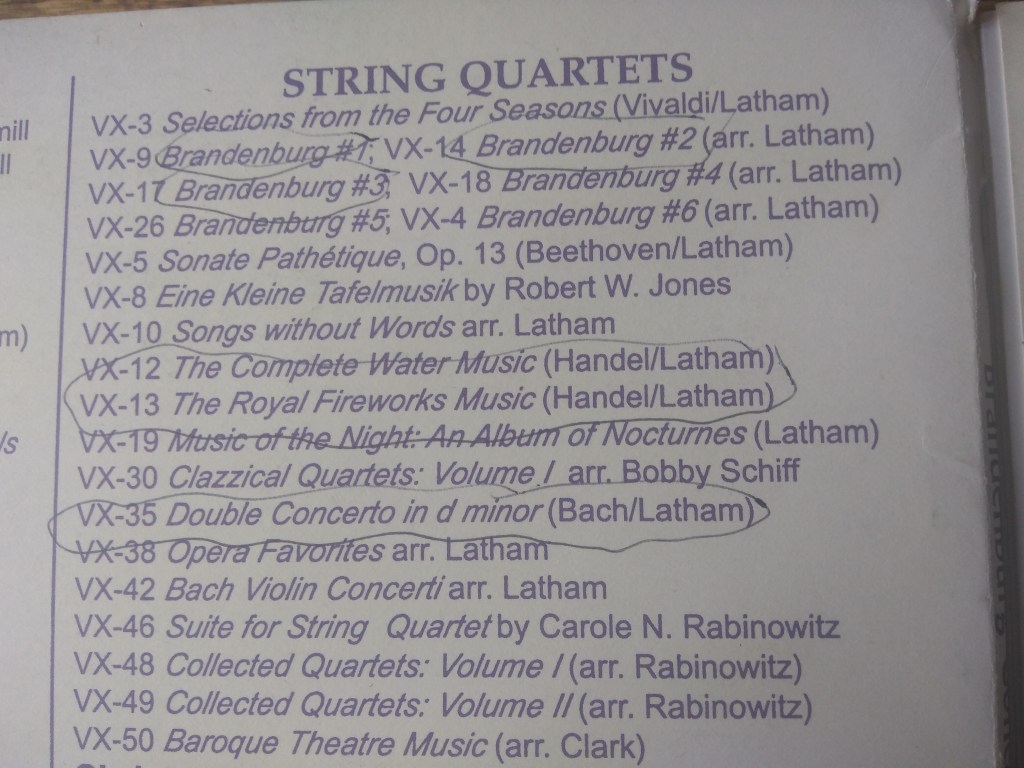
I have attached an image from the back of the music, showing what’s available. The ones I have are circled. Included are arrangements by other arrangers, but I haven’t tried any of them.
I have looked at arrangements for string quartet by other arrangers, and none of them seem to be able to manage the magic that Lynne Latham has. I may be biased, she was a skilled cellist as well as an arranger.
Her arrangements are available on the internet, to purchase and to download. Unfortunately, the links I have so far are for american websites.
SheetMusicNow for downloads. SheetMusicPlus to buy.

Over the years I have played a good deal of Haydn’s quartet music. Not for nothing is he known as the Father of the String Quartet. Quite a lot of his output is playable by even modest players (like me) and all of it gives pleasure. There always seems to be a hidden chuckle just around the corner, and many a time we have ended up a movement grinning at each other from sheer joy.
What I have just discovered (don’t laugh) are the Opuses 1 and 2. If like me you own the Peters edition ’30 Famous Quartets’ you might not even be aware of them. Well hidden Haydn …
In fairness, the ‘Well Tempered Quartet’ qv gives them an honourable mention – ‘For beginners there can be no better course than to go through the quartets in the order he wrote them – the players for whom he wrote them trained and developed their art in that very way’.
However, the weird numbering in Peters’ Editions hides them very well, and at the age of 78 I have just played Opus 1 No 1 !! And very nice it is too.

Sorry I haven’t been updating the website much/at all. Frankly, the response has been disappointing – it seems as if quartet players don’t look at the web much, or don’t want to make their playing too public.
Anyway – an update. I have been branching out in the composers I have found music for – Frank Bridge for example. There is plenty of his music on IMSLP .
https://imslp.org/wiki/List_of_works_by_Frank_Bridge
Three suggestions are –
H.44 Noveletten
H.64 3 Pieces for String quartet (Unfortunately not on IMSLP – try Clevedon Music. https://www.clevedonmusic.co.uk/ )
H.67 3 Idylls for string quartet
Of these, the 3 pieces is the easiest. Frank Bridge was a viola player, but seems to have strange ideas about the ability of cello players to use the upper reaches of the instrument (what we call the ‘dusty part’) – he goes along nicely and then suddenly launches into tenor clef with 6 ledger lines !
I have tried the official ‘String Quartets’ of which there are 3 (4 ?). The first is just possible, and very nice to listen to – the others test the ability (and the tolerance) of even very good players.
Hi everyone
The last week or two have been very sad from the music point of view. Many professional musicians have lost their entire livelihood, and even us amateur players have seen all our quartets, rehearsals, concerts etc cancelled.
I have been looking at the prospects for ‘remote’ playing. My wife and I are in ‘lockdown’, so we don’t want to meet up with our regular quartet friends. Various apps like Whatsapp seem to offer the prospect for playing together over the internet.
First step – make sure your friends are all enrolled into Whatsapp (free). Then set up Whatsapp on (preferably) your tablet or laptop – the bigger screen helps.
Now call your first player, using the ‘video link’ symbol. If it’s all working, you should appear on your own screen, with a box (top right) showing your distant chum. To add more players (max 4, how cool is that !( just click on ‘add players’ and dial them up.
That’s as far as I’ve got. I’ll report more when we’ve managed some actual playing.
Last week was amazing – I played cello in three different quartets, in addition to the rehearsals for Stroud Symphony Orchestra and the concert !
The first session was actually a flute quartet – the flute makes a fine ‘first violin’ ! First we played Pleyel’s Op 20 No 3 – mostly quite easy, simple and charming.
Then, as it was nearly April’s Fool Day the conversation turned to ‘foolish’ or ‘joke’ music. Haydn’s Op 33 No 2 nicknamed ‘The Joke’ was an obvious choice. It’s full of fun and not too difficult. I’ll leave you to spot the joke.
Then to give our flute some fun we played Mozart’s flute quartet K285a (in the edition by J-P Rampal – International Music Co) – followed by K285 itself (same edition). Two quite different pieces, oddly.
The same evening (different quartet) we played K285 again, but in the Peters Edition, and with a 1st violin not flute. Different, but equally successful and a delight to play.
And the next afternoon, with quartet 3, we played a much more demanding piece, Mozart’s ‘Hofmeister’ quartet K499. Both the adagio and the finale have quite complicated rhythms – worth looking at beforehand !
Followed by a concert including Elgar’s Enigma Variations. Quite a week !
I have mentioned the wonderful book called ‘The Well Tempered Quartet’ in a previous post. I thought it might be of interest to post the views of the WTQ’s authors on the subject of Beethoven Op 18.

The last few words (p60) are ‘The Rondo section demands light and flexible wrists. At the change of tempo, do look carefully at one another to ensure unanimity.’ As if we wouldn’t !
Last night’s quartet music was a surprise – our viola player had found some very old copies of Beethoven’s Op 18. Yellow with age, heavily annotated, with some very useful fingerings pencilled into my part. Someone had enjoyed these a good many times.
Of the 6 quartets I picked number 3 – purely because it’s the one I’ve played most often, which is a pretty poor reason, thinking about it. It was fairly new to the others, but we had a good shot at it, and enjoyed it. I think it is probably the easiest of the set. One to go back to !
Our leader thinks that it’s not Christmas until we’ve played the string quartet arrangement of Corelli’s ‘Christmas’ Concerto – Op 6 No 8. Lovely piece, and not too difficult. We all enjoyed it.
(Incidentally I had played it the previous week at our ‘For Fun’ cello group – with 11 cellos ! Fortunately I had the actual cello part – the other parts are high – very high …!)
(String quartet parts are available on IMSLP here)
IMSLP stands for the International Music Score Library Project. It is, without exaggeration, one of the most useful and far-reaching resources on the internet for all practical musicians. The library is very well organised, with comprehensive indexes, so it makes finding printable copies of string quartet music really easy – and it’s FREE.
For a lot of the works for string quartet, there may be several versions in the library. Usually there is a scan of an early published version, but for some works there is also a version which has been typeset to modern standards by a volunteer.
A snag with downloadable versions of sheet music is that it might be quite tricky to actually print it out. Some of the versions may be in ‘music’ size (12 x 9 inches), which won’t fit on to an A4 sheet (11.5 x 8 inches). You will need a bigger printer, or accept rather cramped music. Always use good quality paper, at least 100 gsm, otherwise print-through can be a problem. And pay attention to page breaks – the edition might be laid out with convenient rests at the end of certain pages, to allow for turning over. If there are 4 bars rest at the end of page 1, make sure you leave the left page blank, print page 1 on the right, and then you can turn. Hopefully, there will be a handy rest (or end of movement) at the end of page 3 !
 Play String Quartets !